
The world of violin and classical music is governed by many elitist rules, both inside and outside the concert hall. Not knowing them will undoubtedly expose you to a lot of haughty looks. That's why I thought I'd take this opportunity to show you how to hold your violin - well, especially other people's violins. As you'll have gathered, I'm not talking about the musician's outfit in action, but rather that which will enable you to admire an instrument as a whole.
How to hold your violin
Even if this article is intended to be humorous, the way a violin is handled is important. In fact, it's not just to satisfy the purists, but to preserve an instrument as much as possible that you should avoid handling it. Especially when we're dealing with a fragile, often rare and expensive piece.
Of course, since they're not museum pieces, they're bound to come into contact with the hands in some way in order to be played. That's why, despite all the recommendations I could make: any abuse of the violin is excusable (or almost) when you play it. It is, however, more problematic when you don't intend to play it...
Avoid touching the varnish
Perhaps you've heard of the game The floor islava? On the violin, it's the same principle: any red, orange or yellow parts(well, sometimes they're also very, very dark brown...) are to be avoided at all costs. In other words, it's best to avoid touching varnish or bare wood wherever possible. Not only will this dirty or damage the surface, but it can also lead to undesirable chemical reactions.
Le vernis est une couche protectrice qui entoure la majorité d’un violon, d’un alto ou d’un violoncelle, du moins lorsqu’ils sont neufs. Il se compose de différentes ingrédients qui le rendent plus ou moins dur. Certains d’entre eux peuvent mettre de nombreuses années à sécher, voire à rester « fondant » pendant des dizaines d’années. C’est pourquoi cette fine pellicule, brillante et propre à l’origine, peut se retrouver matte, rugueuse et encrassée.
Of course, it's not the end of the world if we delicately grasp a violin by a varnished surface for a few seconds. At the very most, it's likely to deeply shock its owner, who will have spent hours meticulously cleaning every nook and cranny. That's why it's always a good idea to be careful, so as not to get angry with a friend(or stranger) whose instrument you'd like to observe.
Enfin, cela fait aussi partie de la vie du violon de perdre progressivement son vernis. Cela dessine son histoire, en sachant qu’un vernis peut se retoucher, mais par principe ne se « refait » pas.
But which parts to hold?
There are actually three parts designed to hold a violin securely:
- The handle
- Chin strap
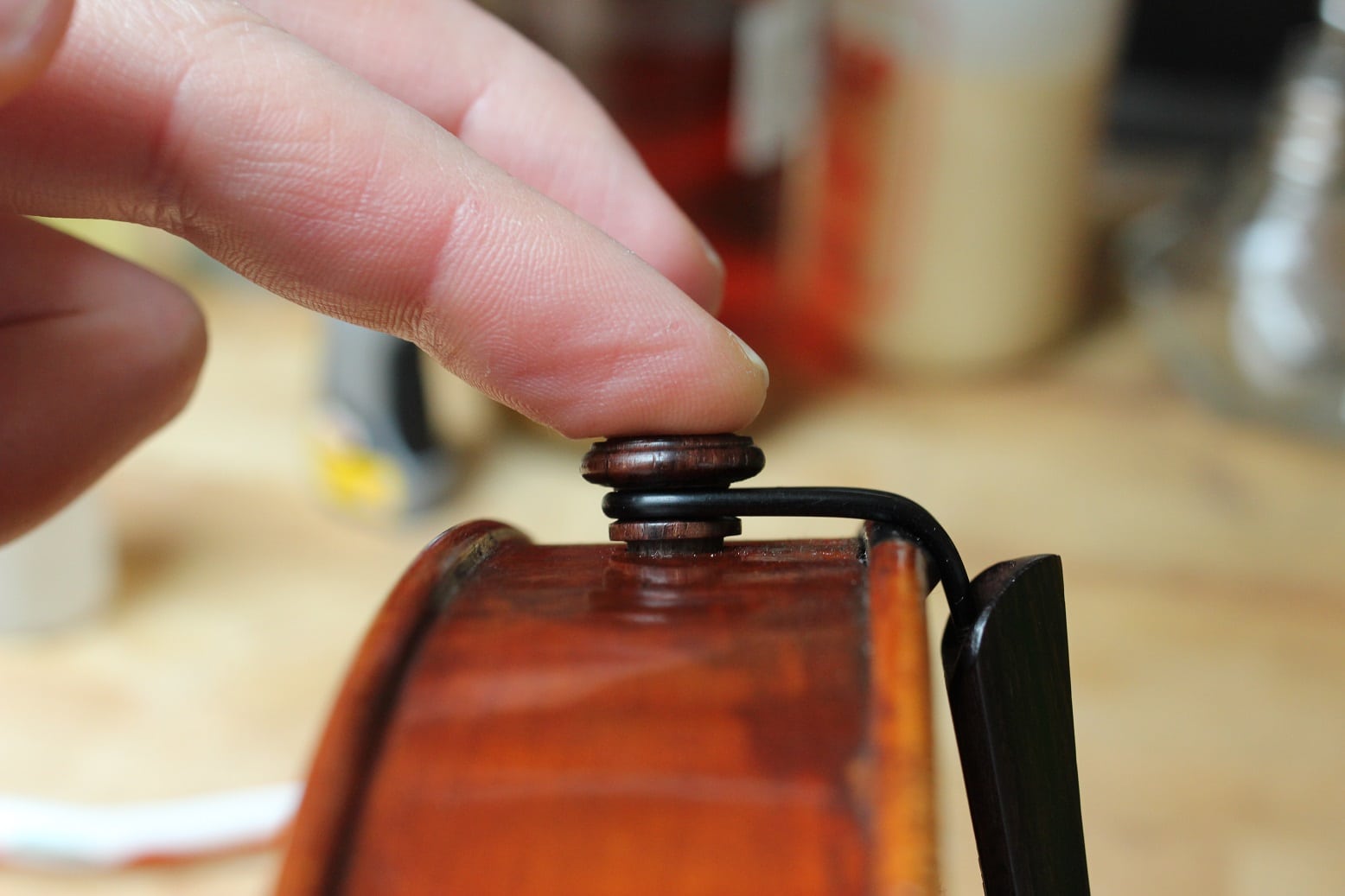
- The button
These three unvarnished surfaces allow you to hold your violin securely and observe it in its entirety without any risk.
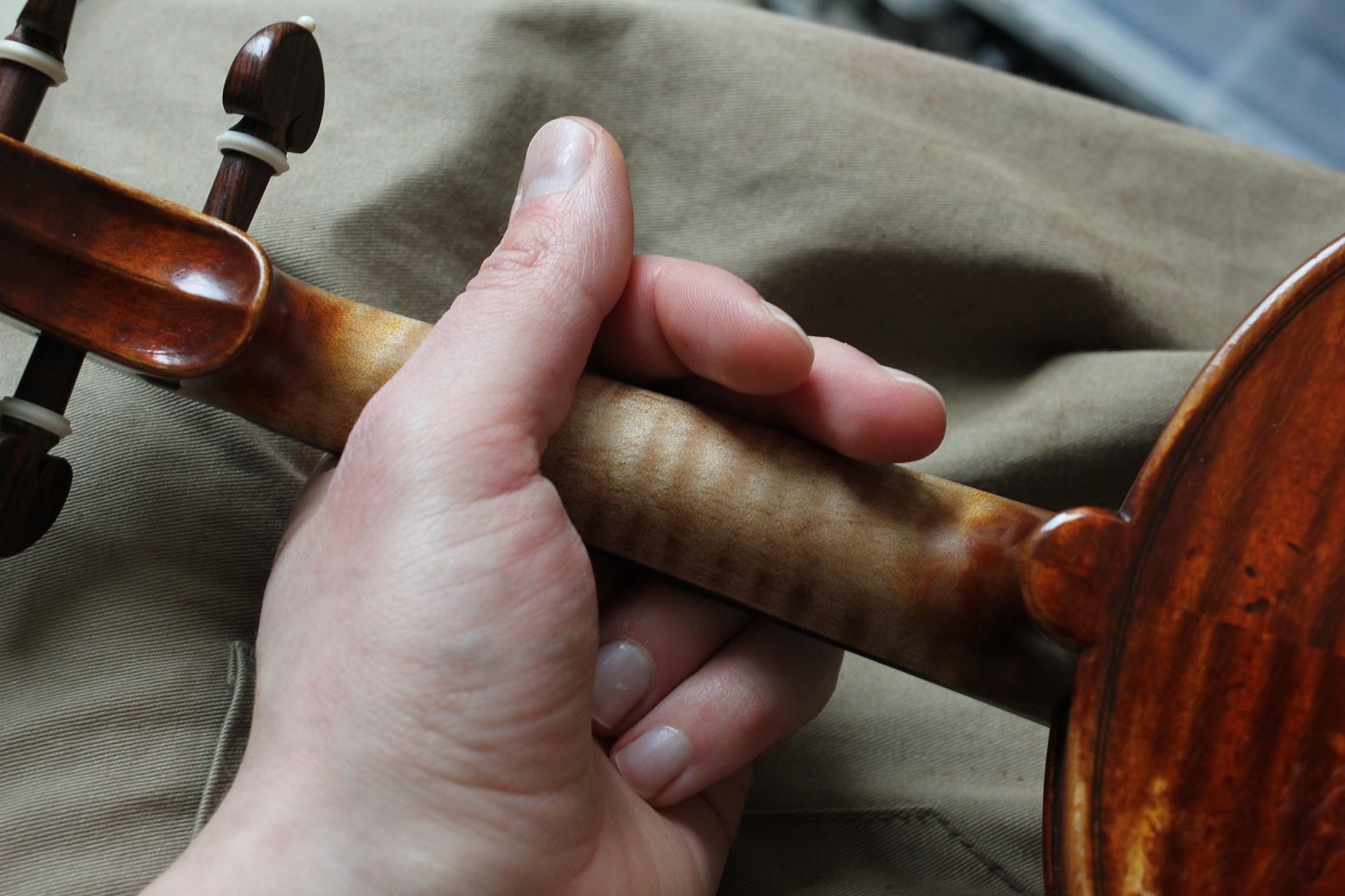
The best way to do this is to grasp the handle firmly with one hand. The index and middle fingers of the other hand will support the button. If a chin rest is present, it will increase this contact surface. Because, let's face it, relying solely on a tiny button can be tricky. But I'm not worried about you, skilful musicians that you are.
This makes it easy to observe every corner of the instrument, simply by rotating it.




One comment