
I get a lot of questions about my job, especially about my career path and my choices. It's also true that I take on a number of trainees, many of whom want to go into this career. I still have a lot to say on the subject, and I hope this article will give you a clearer picture of the reality. In fact, despite the title, which could be misleading, I'm not going to explain in detail "how to become a luthier" but rather "why(not) to become a luthier".
How to become a luthier in general
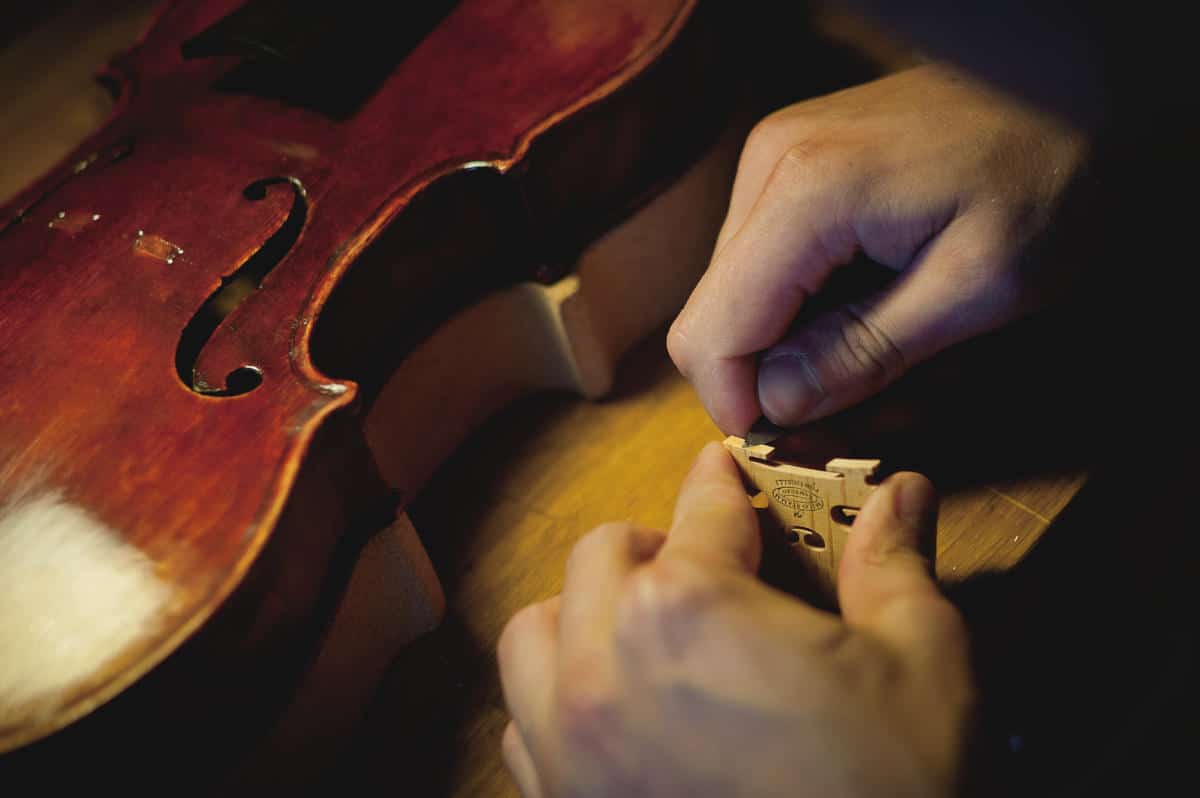
In fact, becoming a luthier is very simple: it's not a regulated profession. That's why anyone can call themselves a luthier: no diploma, no certificate of expertise, no competition. All it takes is a few tools and a bit of nerve to start your own business.
But in reality, the usual route for most luthiers is to go to a school(public or private). Here, they can acquire the basic skills that are only the first steps on their career path.
Each of us will take a very different route to acquiring the necessary knowledge. In fact, it's a good idea to start by asking yourself: what do I want to do as a luthier?
Violin-making courses at the workshop
Discover the world of violin making and create your own instrument.
What are the qualities of a future luthier?
It's a question that comes up quite often, and that's why I wanted to talk about it. I'm sure everyone will have a different opinion on the matter, but here are my thoughts on the fundamental qualities needed. I'm not going to talk about skills, because honestly, nothing else prepares you for the job. And at the same time, any additional skills are good to have.
Passion
It will be necessary in any case, because you're going to have to love what you do. That way, you'll have enough energy to pursue this quest without faltering, and face the routine of a rigorous and demanding apprenticeship.
Patience
Patience is surely one of the key qualities of lutherie. Hardly adapted to the modern world, it is nevertheless a very important quality that should not be underestimated. Observe, understand, be attentive and observe every gesture, every curve, return tirelessly to your work and go further.
Perseverance
Persistence, perseverance, of course you'll need a lot of it. Because I can tell you right now, you're going to be disappointed, you're going to fail a lot... Not that you're inferior, but as the saying goes: "The master has failed far more than the apprentice has ever tried". You too will have to pick yourself up and get back in the saddle.
Precision
Violin making requires you to think in terms of precision on a different scale. There's little room for approximation, and even if there's sometimes a certain tolerance, your eye and hand will quickly have to learn to work to 1/10 and even below.
Perfection
I can already tell you that perfection will never be achieved. But wanting to achieve it will always be a motivation that must carry you forward. Do your best, do better than the best you can do.
Polyglottism
I don't know if it's a skill or a quality... But be open to the world, be open to languages, travel and encounters. Otherwise, you're putting huge obstacles in your way. Master English, the professional language par excellence, which gives you access to an almost inexhaustible source of knowledge, opportunities and contacts around the world.
If you have these qualities, you've got what it takes to become a professional luthier without sputtering. If you don't, there's nothing to stop you taking the time to develop them.
The luthier's journey
I mean, what do you think a luthier does on a daily basis? I mean really...
Do you think there's an archetype that everyone models themselves on in order to find the path to professional success? Yes, in fact, there is. It's a bit like family imitation, or what we call transmission. In other words, the older generation passes on to the younger what it has built up, and passes it on in this way over the years. A pattern that has worked perfectly for centuries, but is it still valid in the world we live in today? While lutherie is a craft that conveys a great respect for tradition and the preservation of heritage, it must nonetheless adapt to the frenetic evolution of the modern world.
It's normal to be strongly influenced by our masters, their values and habits. However, it's important to be able to extricate ourselves from these influences and make them our own. In this way, it will be much easier to find one's place in the world of lutherie and, above all, to feel good about it.
How to make a living as a violin maker
In fact, when choosing a career, it's essential to consider how to earn enough money to survive... and even better, to live comfortably. I often hear, "lutherie is fantastic, it's a passion job..." In other words, we indulge ourselves and live our dreams all day long, working in the quiet of a workshop that smells of wood and hot glue. We probably spend our days tirelessly observing the different shapes that follow one another in a volute, while holding our chins in a pensive mood.
Passion is good, but it's not the job that's going to fill you with passion. In fact, it's your inner passion, tenacity, willpower and courage that will keep you on the right path. Because, as on any road, there will be many obstacles, and I'd go so far as to say they're far greater on this one. But nothing dramatic either...
The luthier's various activities
In many cases, lutherie is a very individualistic profession. It's also a very personal profession, and there are many ways to practice it. Here are just a few of the ways a craftsman can earn a living:
- Instrument making
- Accessory manufacturing
- Repair
- Catering
- Assembly
- Settings
- Bow re-drying and maintenance
- Equipment rental
- Instrument and accessory trade
- Expertise
- Teaching
- Consulting for manufacturers
- Sales agent
- And the rest, which is limited only by the imagination.
How do you become a luthier today?
In fact, as I said earlier, you'll almost necessarily have to go to a specialized school(I'll list them in another article sometime).
These schools will by no means turn you into a luthier. They will simply give you a few basic skills that will eventually enable you to access internships, or a first job in which other craftsmen will be willing to pass on their knowledge to you. Some people decide to go it alone straight from school, but this is a much riskier initiative.
The apprentice luthier's tools
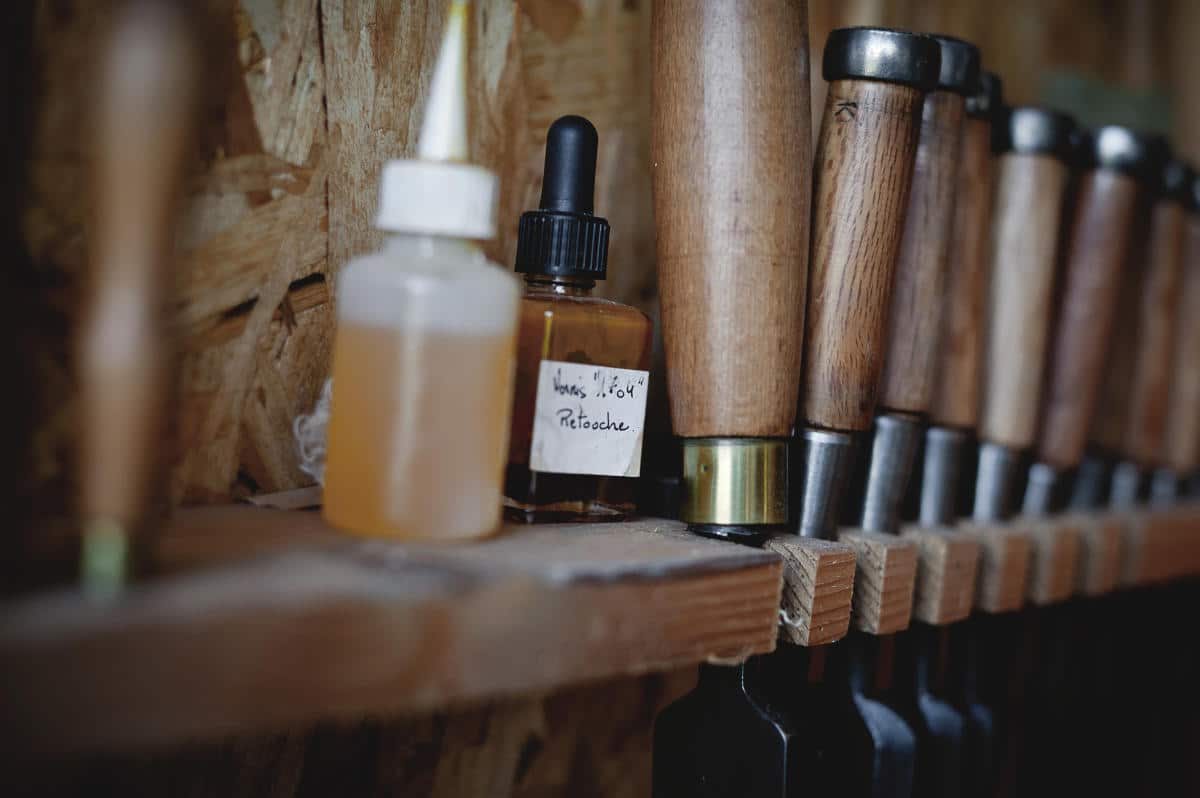
Here are a few useful tools to get you started.
The good and bad sides of a violin-making school
As I was saying, violin making schools don't give you all the keys to success. In fact, most of them won't even give you the right keys to make you employable, which is quite absurd. Before choosing one of them, it's a good idea to think about exactly what you're looking for and understand what you'll be learning at each establishment. Depending on your personality and also your objectives.
Generally speaking, if you don't get out of the school bubble, you'll find it hard to get to grips with the economic realities you'll have to face later on.
What an employer is looking for
An employer is obviously looking for someone who is serious and motivated, but that's not all: there are certain skills that will be absolutely essential to land a job in a workshop. In my opinion, these are the really important notions to acquire during an apprenticeship:
- Complete assembly of violins, violas and cellos to a professional standard, and fairly quickly.
- Be able to carry out basic repairs and restorations independently and at the right pace.
- Be able to perform basic manipulations on an instrument(changing strings, tuning, etc.).
What employers aren't looking for...
...and that all schools spend their time teaching: how to make instruments.
Of course, it's important to know how to build a violin, viola or cello. It helps to learn how to use many tools, to understand how all the parts fit together, to make sure you acquire enough woodworking skills. And while showing off your violin will be far more valuable than the most complete and beautiful Curriculum Vitae, you will only in very rare cases be hired to do this work. Worse still, many employment contracts will prevent you from building your own instruments.
Beware: some courses require you to build several instruments in white, without assembly or varnish...
That's why I advise you to pay close attention to your school's curriculum before choosing it. Likewise, you can always supplement your training with internships or personal work. That's why I offer professional training courses.
[blog_posts ids="24931″]
How to choose your school
If I were to give you advice based on my own experience, here are a few points that I feel are essential when choosing a school:
- Don't go to school in your home country. Take advantage of the opportunity to learn another language, experience another culture and meet new people.
- Connect with your peers. Connecting with your peers is where your professional network begins.
- Choose a school with a complete program. In other words, a school that introduces you to all aspects of contemporary lutherie: making, repairing, restoring, assembling, varnishing and, if possible, professional experience.
- Prepare your hiring or start-up project long before you graduate. Prepare your networks, adapt your knowledge and sharpen your tools.

A few words for the future luthier
If you go through the doors of luthiers near you(and those far away too, I assure you), you'll very often get rather austere reactions if you tell them about your career plans. And that's perfectly normal; I had the same thoughts at the time, and I still hear them today from colleagues.
To put it bluntly, there are too many luthiers. There are more and more of them, that's what we hear. And these days, it's even trickier: a highly competitive world, between the Internet and its sprawling cyberstores, amateurs, the multiplication of workshops in urban areas, fewer and fewer violinists, violists and cellists...
If you would like to gain a better understanding of the instrument-making market in France. I invite you to read this 100-page study, which deals with the subject in depth: https: //www.csfi-musique.fr/item/131-grande-etude-economique-2017.
How do you become a luthier?
If I've frightened you, so much the better, because even if it's not necessarily that bad, I still want to make you aware of a certain reality. Read, find out and make up your own mind. Then confront it with what you want to do, you're the only judge.
However, you mustn't give up - after all, you have to persevere. And this will be your first test. If you give up as soon as the slightest difficulty appears, I think it's wiser to opt for another path. Otherwise, you certainly won't be able to blossom.
In the future, I'm going to try to tackle other subjects that will make it possible to approach the subject of violin making in a more economical way. For example, I'd like to present you with a simplified forecast for a violin-making workshop.
In the meantime, if you have any further questions, I invite you to discuss them on social networks, send me an e-mail or call me directly.




Hello, I've been an oncology nurse for 13 years and I've been wanting to switch to violin making for a long time. I don't know where to start, so I'd like your advice. I have a family and I live near Caen.
Hello, what type of violin making would you like to do? There are many ways to become a luthier, but the best way will always depend on you and your expectations.
Hello,
My son is very interested in this profession. He has already made some "decorative" guitars, but wants to go further and has a lot of questions.
He's not at all academic, and the idea of going back to school makes him feel cold. He's 18.
Hello, I'm a 15-year-old guitarist and I'd like to become a luthier but I don't know how to get started.
Can you point me in the right direction?
Thank you for your answer...
Hello,
To become a luthier, you need to start by learning the trade, for which there are schools and apprenticeship schemes. Depending on where you live, you'll need to find the most suitable solution. Depending on the instrument you want to work on, the school will be different, as will the tools and techniques. You'll also need to be patient and motivated, because it's going to be a tough road to travel.
Bonjour
Merci pour ce texte et ses informations très pertinentes ,elles me donnent à réfléchir, j ai 60 ans , chef atelier pendant 40 ans dans une belle marque automobile allemande, je serais dans quelques mois à la retraite, je cherche à me reconvertir ,sur un métier à contre.temps que celui j ai exercé pendant tant d’années, je souhaite prendre du temps ,je suis Minutieux perspicace, j aime le bois ,et la musique, j aurais souhaité me tourner vers le métier de la lutherie, pas pour en vivre ,mais pour vivre ,tout simplement, peut être en faire un petit complément de revenus , j ai vu sur Toulouse, une école…pourriez vous me guider ? Ou m2 donner votre ressenti ? Thierry