The violin is considered by many to be a perfect alchemy of technical achievement and artistic aestheticism. What room is there for innovation when departing from the traditional form is considered: impossible(it would no longer be a violin, but another instrument), superfluous(the violin is already perfect, why improve it), intolerable(musicians wouldn't want to play it). If it were possible to change or even improve the classical violin, where would we start? Let's start by looking at where the violin came from, how it has evolved over the centuries, and begin to envision the future of instruments imagined by today's luthiers, with the help of engineers, acousticians and new materials.
The evolution of the violin over the centuries
It was in Cremona in the 16th century that luthier Andrea Amati created the violin in its near-perfect form, using simple mathematical and architectural principles. Since then, the instrument has not really evolved radically. It's really just a matter of minute details. At the dawn of the eighteenth century, Stradivari and Guarneri Del Gesu built the models most renowned today for their performance in concert halls. The luthiers of the following centuries lived in the shadow of these Cremonese grandmasters, merely seeking out the secrets they had taken to their graves: the methods, the materials and how to use them.
It was during the 19th century that the violin underwent its most radical evolution, the so-called modern set-up. It was really just a question of lengthening the vibrating length and adapting to higher string tensions. The necks, keys and sound bars became longer. Almost all early instruments underwent these changes to adapt to the new criteria. That's pretty much the story of the classical violin.
Part of the profession's energy is focused on mechanizing production, creating and improving strings and accessories, and replicating or counterfeiting old instruments. On the other hand, modern lutherie is busy developing ever more sophisticated restoration processes to keep alive all the antique instruments we have inherited. Of course, there has been an evolution in the knowledge and techniques that revolve around the violin, but very little impact on the instrument itself.
The violins of innovation
Here are a few violins with innovative approaches. These ideas may be old or new. These are just a few examples of attempts to improve or re-imagine the instrument, among many others. None of them really seem to have the potential to jeopardize the future of the classical violin.
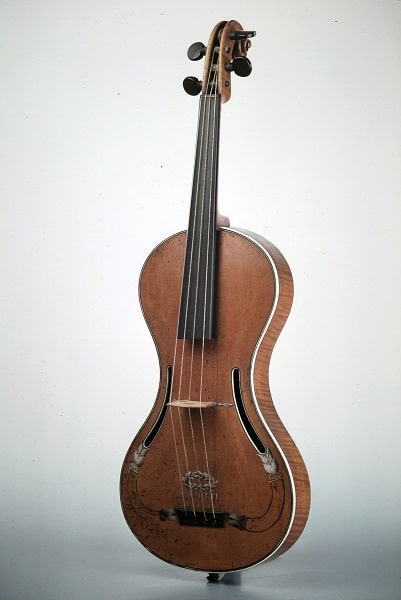
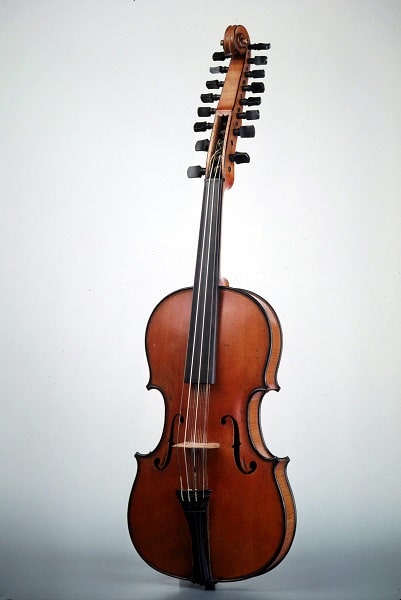
The Chanot violin
The violin proposed by François Chanot in 1819, while retaining the overall shape of the instrument, was also very different from its original model. The top and back did not have protruding edges. The ribs and gills were slots of constant width that followed the edges of the table. The headstock was turned upside down to facilitate stringing. Worst of all, the tailpiece was glued directly to the soundboard, like that of a guitar. The final consequence was that the table was ripped off. Despite rave reviews for sound and price, the instrument was not widely adopted.
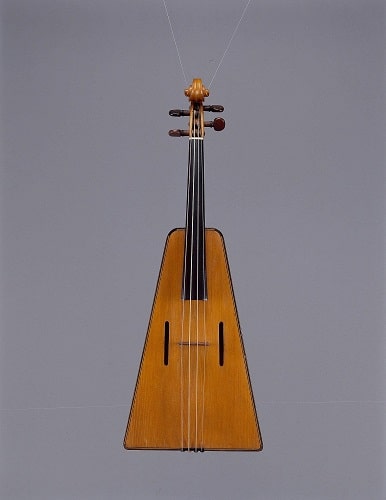
The Savart violin
Félix Savart was a 19th-century physicist and acoustician who proposed to correct certain problems in the design and sound of the classical violin. Unfortunately, the result was inconclusive, as it created other sound, aesthetic and handling problems that were far more serious than those it was intended to correct. The idea was immediately abandoned.
The bell violin (Stroh)
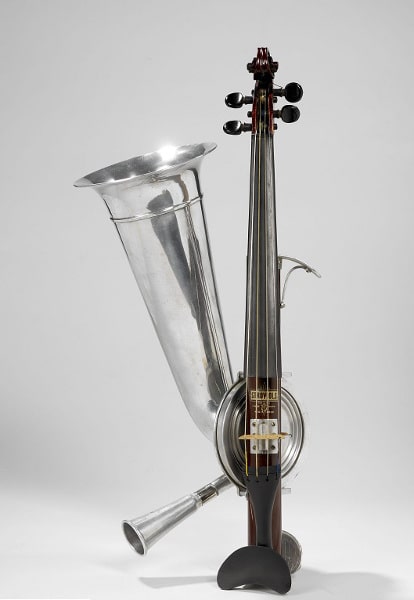
Augustus Stroh designed and patented a tableless violin in 1899:
"The bridge is placed in such a way as to transmit the slightest vibrations to a lever; this lever is itself in communication with an aluminum diaphragm. This diaphragm is the main part of the violin; it gives the necessary force to the sound; it is fixed by two rubber pads to the frame of the violin. Next to the diaphragm is a metal bell that serves to reinforce the sound.
The Stroh violin was used for some time for phonographic recordings, its power solving the problem of insensitive microphones. After that, its use probably continued to decline, since testimonials about it beyond the early years are rare, and there is no data available to assess how many examples are currently being played.
The carbon fiber violin
Derived from nautical and aeronautical technology, the use of carbon fiber was intended to answer many of the questions raised by craft and industrial lutherie: how to produce top-quality instruments at low cost. Assemblies of fiber and resin enable the creation of instruments that are both light and very rigid, theoretically providing the best conditions for sound propagation. Apart from the lack of aesthetic appeal, these instruments are rather dark and boring. At first sight, their sound is rather flattering: powerful, clear and precise, but in the long run they are often overlooked for their flatness, lacking complexity and personality.
The recycled violin
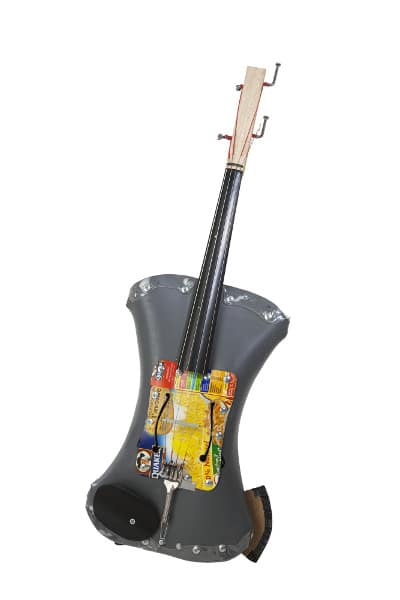
The recycling of materials has enabled many musicians to create their own instruments. Violins made from cigar boxes and broomsticks have sprung up all over the world. It's an exercise in creativity, no doubt akin to the experience of the early pioneers of instrument making. Of course, these violins are of little interest to musicians, as their performance is very limited. Rather, the genius lies in the use of random materials and shapes that could perhaps give rise to the next great innovation.
[kad_youtube url="https://www.youtube.com/embed/0DRxPYOeNjg " maxwidth="600″]
The 3Dvarius
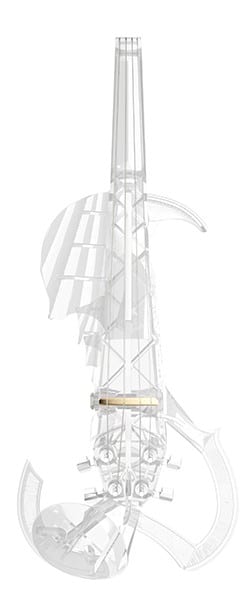
This is more of a technical innovation in terms of the instrument's construction. In fact, this violin is totally 3D printed with a synthetic resin, so there are no cut-outs or assemblies, just a single block. Although this really is an electric violin, with its own advantages and disadvantages, its production price is still rather high(retail price on the official website: from 6999 euros).
[kad_youtube url="https://www.youtube.com/embed/Z0ni05PZRUw " maxwidth="600″]
What's next?
These days, new ideas and inventions of all kinds flourish daily in workshops around the world. And even if the violin of our ancestors still has a very bright future ahead of it. We're not immune to a total upheaval in our way of seeing or thinking about the instrument. However, it is more plausible that these advances will be more gradual and sprinkled with small touches of genius. Let's meet up again in a few years' time to take stock.