
Bien que l’usure d’une corde frottée soit inéluctable, comprendre ses principaux facteurs vont permettre de mieux la contrôler. C’est pourquoi je vous invite à découvrir ce qui va déterminer la durée de vie des cordes de votre instrument et vous donner quelques pistes pour pouvoir les conserver aussi longtemps que possible.
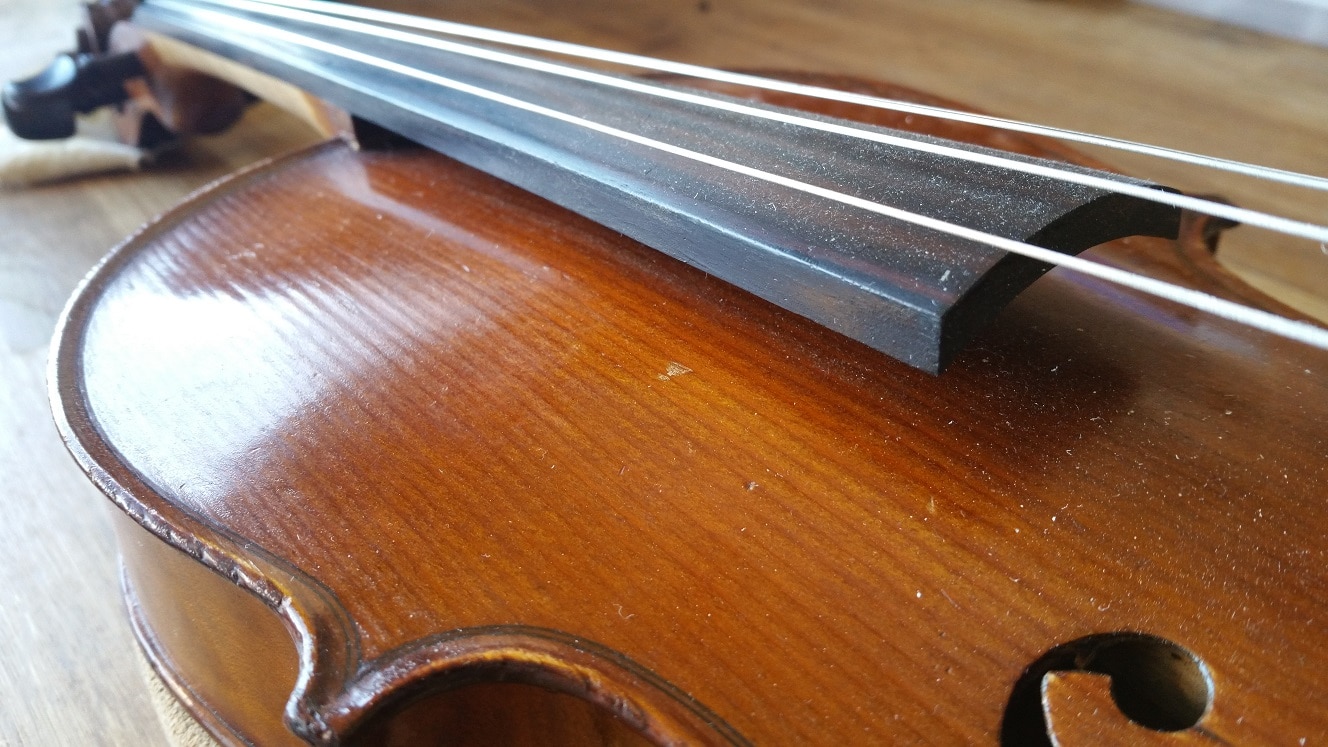
Quelle est la durée de vie des cordes ?
Beaucoup de musiciens se posent la question à propos de la durée de vie des cordes. Par exemple, « à quelle fréquence faut-il que je change mes cordes ? » ou encore « Comment augmenter la durée de vie de mes cordes ?« . Ce n’est pas une question à laquelle une simple réponse suffit. Il y a en effet de nombreux facteurs qui vont déterminer le vieillissement d’une corde de violon, d’alto ou de violoncelle.
Il faut dire que le seul fait de mettre les cordes sous tension est déjà un facteur d’usure, même si celui-ci est infime. Ceux qui ont le plus d’influence sont en fait l’usure mécanique, la contamination et la corrosion. En fait, tout ce qui aura vraiment de l’influence sur la longévité des cordes va dépendre de comment celles-ci sont manipulées et utilisées.
L’usure mécanique des cordes
La corde va s’user plus rapidement sur les endroits de frottement, contre des surfaces aiguës ou abrasives. De même, les changements d’angles trop durs auront tendance à abîmer les rubans..
Les points de fragilité principaux sont les suivants :
- Premièrement, des passages de cordes trop étroits ou un angle inapproprié sur le sillet.
- Ensuite, des rebords tranchants sur les chevilles.
- D’autre part, sillons du chevalet sont peut-être trop profond et/ou trop étroits.
- Enfin, il faut aussi surveiller les ajusteurs fins et les crans du cordier qui ne doivent pas être trop tranchants.
Une corde ne doit jamais casser si elle est utilisée d’une manière normale. C’est pourquoi si vous avez de la casse, vous feriez mieux de faire vérifier votre instrument chez un luthier pour qu’il arrange le problème.
La contamination des cordes
Dans la région de la touche, celle qui est en contact avec les doigts, la contamination se fait par de nombreuses substances. Nous y retrouvons par exemple des sels, des acides gras, de nombreuses salissures aux origines diverses, de la poussière et des peaux mortes. En fait, c’est un peu le même type de pollution que vous retrouverez sur votre téléphone portable ou le clavier de votre ordinateur après quelques temps d’utilisation.
Tous ces éléments plus ou moins microscopiques vont s’accumuler de plus en plus profondément à l’intérieur de la corde. Ils vont se mélanger à la structure et peu à peu émousser la vibration.
Beaucoup d’entre nous pensent qu’il est en fait possible de prolonger la vie d’une corde grâce à un nettoyage régulier. Toutefois, essuyer toute la longueur vibrante de la corde afin d’en prévenir la contamination et la corrosion n’est pas aussi efficace que nous pourrions l’espérer.
La structure d’une corde est relativement complexe et se retrouve affectée par la pénétration en profondeur de nombreux détritus lors de son usage. On pourrait croire tout d’abord que l’enfermer dans une gaine étanche serait une solution simple pour empêcher ce problème. Mais dans la réalité, c’est purement impossible en raison de la façon dont se propage la vibration. En effet, tous les bobinages qui sont présents sur la corde doivent conserver une certaine indépendance pour pouvoir vibrer librement.
En conséquence, il n’est pas vraiment possible de protéger une corde contre la contamination. Il n’est pas possible de nettoyer la corde en profondeur, même si vous trouverez beaucoup de nettoyants sur internet qui sont supposés faire ce travail.
Toutefois, il est tout de même important d’enlever tout ce qui se trouve à a surface des cordes. D’ailleurs vous pourrez vous référer à mon article sur comment nettoyer ses cordes.
Une contamination en profondeur
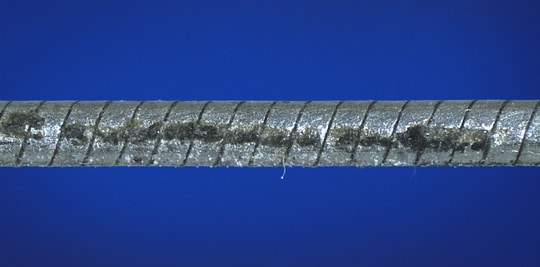
Les saletés se déposent avant tout sur l’extérieur des cordes. Cela affecte évidemment la vibration de celle-ci mais cela a encore plus d’incidence lorsque cela pénètre sous le bobinage. Ces dépôts peuvent être évités en se lavant simplement les mains avant de jouer.
Sur la photo, la corde a été présentée latéralement, car les dépôts ne se présentent jamais aux endroits en contact avec la touche ou les doigts mais sont repoussés sur les côtés.
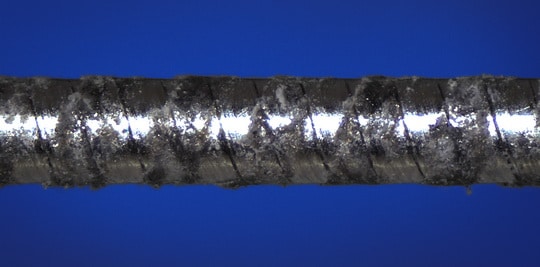
Lorsque nous enlevons le ruban extérieur de la corde et que nous observons au microscope, nous constatons la présence de débris sur le second ruban. Cela montre bien que les dépôts peuvent pénétrer en profondeur. Toutefois, ceux-ci semblent généralement ne pas aller plus loin si ils ne sont pas emportés par des liquides au plus profond de la corde.
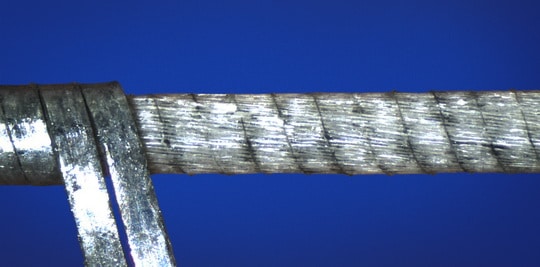
Si nous mettons l’âme de la corde à nue, nous apercevons là aussi la contamination qui atteint le cœur de la corde. Par exemple, si vos mains transpirent beaucoup, il est assez facile d’affecter le bon fonctionnement de l’ensemble de la corde. Cependant, si ce n’est pas le cas, il n’y a en fait que très peu de polluants qui arrivent à pénétrer au plus profond de la corde. C’est pourquoi il est toujours plus prudent d’éviter les produits nettoyants liquides qui ne feront que souiller la corde de plus en plus profondément. Car de toute façon il est impossible de nettoyer l’intérieur des cordes.
La corrosion des cordes
D’abord, il faut admettre que certaines personnes ont de plus gros soucis avec la corrosion de l’aluminium que d’autres. Et même si l’hydronalium est un peu plus résistant aux effets de la corrosion, la différence n’est après tout pas tellement significative. Cependant, l’argent ou l’acier inoxydable ne souffrent pas réellement de ce problème de corrosion et se révèlent être une très bonne alternative. Par contre, ils n’ont évidemment par les même propriétés acoustiques.
Il est vrai qu’il y a une grande disparité entre les empreintes chimiques des mains des musiciens. Certains d’entre eux peuvent jouer pendant des années sur tous les types de cordes, même en aluminium. D’autres personnes tout aussi talentueuses vont toutefois détruire une corde de La en aluminium en l’espace de trois semaines.
D’après des recherches scientifiques, le régime alimentaire du musicien y serait pour beaucoup, mais c’est aussi une question d’ordre génétique.
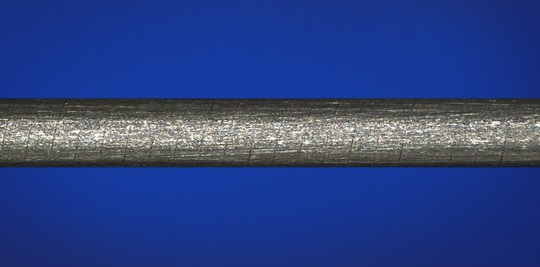
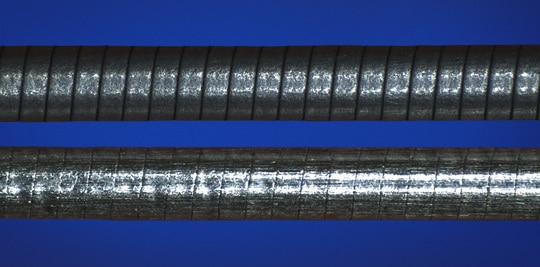
Après quelques temps d’utilisation, une corde en aluminium commencera à s’oxyder et à se déformer. La dégradation commence d’abord par les jointures entre les différents tours du ruban.
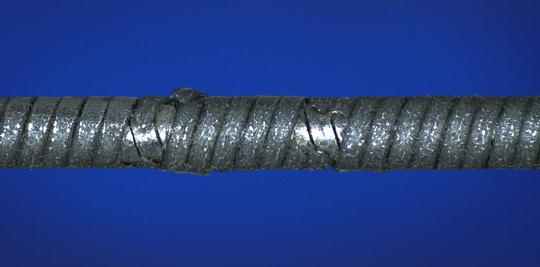
La corrosion de l’aluminium est un problème que doivent affronter la plupart des fabricants de cordes. Il n’y a en fait pas réellement d’alternative possible aujourd’hui qui aurait les même caractéristiques sonores que l’aluminium. Enfin, c’est plutôt que la plupart du temps les constructeurs proposent simplement d’autres métaux moins sensibles à la corrosion.
Comparaisons de situation avec les cordes Warchal
Voici une comparaison entre deux cas d’usure des cordes qui sont, je trouve, très parlant.
Une usure importante des cordes
Il est assez intéressant de constater l’usure de l’aluminium sur les cordes de Ré Brilliant Vintage and Amber de chez Warchal. Elles possèdent une structure tout à fait particulière et unique qui est en fait une combinaison de rubans d’argent et d’aluminium. L’observation de cette structure rend la comparaison de la corrosion des cordes encore plus intéressante.
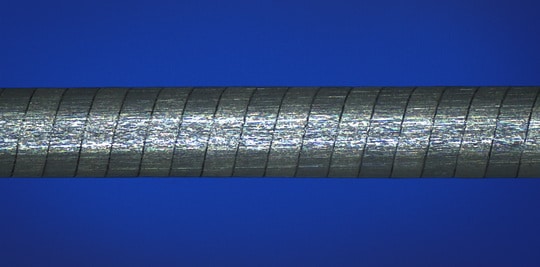
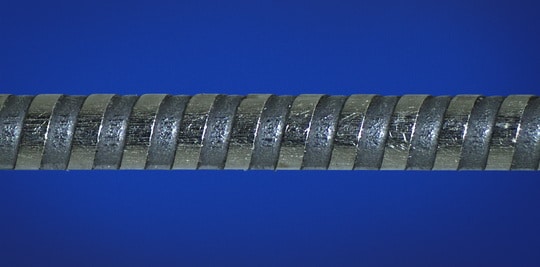
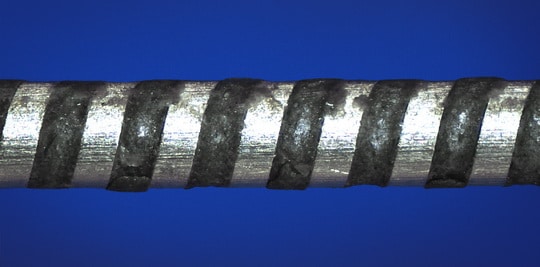
Dans ce cas précis, nous pouvons observer la désintégration de l’aluminium alors que la partie en argent demeure relativement intacte. De plus, il y a une sévère pollution en surface.
Une usure faible des cordes
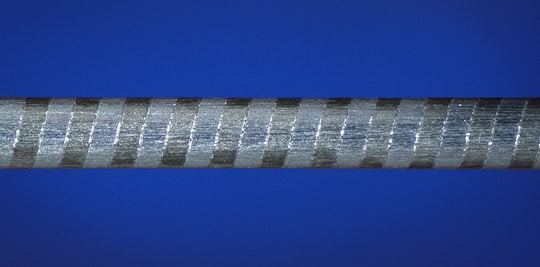
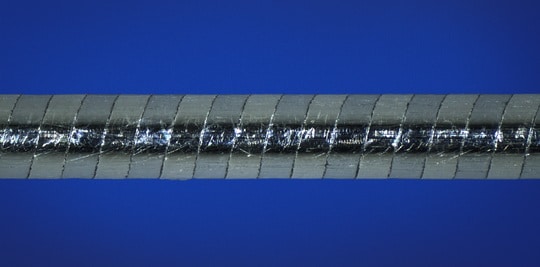
Dans ce ce nouveau cas, une corde Ré Brilliant Vintage a été utilisée de manière intense pendant quatre mois par un autre violoniste.
Sur l’image de gauche, qui a été prise sur la partie supérieure de la touche, proche de la zone d’archet. Nous pouvons d’abord observer que l’argent a été progressivement terni par l’humidité de l’environnement. L’aluminium quant à lui reste pratiquement intact.
Sur l’image de droite, il s’agit de la partie en contact avec la touche qui a été jouée très intensément. Nous constatons que les deux métaux ont été polis par les frottements et qu’il y a également quelques abrasions qui se retrouvent à la surface.
Aucun des deux métaux n’ont été affectés par la corrosion. Le violoniste est un végétarien qui limite particulièrement sa consommation de sucres et de sel. Peut-être qu’il n’y a aucune relation mais en tout cas ce ne serait pas le premier rapport scientifique à nous indiquer que ce que nous mangeons a une influence direct sur l’acidité de notre corps.
Quoi qu’il en soit, chacun fait ce qu’il lui semble bon en terme de régime alimentaire. De toute façon ne vous inquiétez pas, vous pourrez continuer à manger ce qui vous plaît. Après tout il existe des cordes qui ne sont pas aussi sensibles à la corrosion.
Comment augmenter la durée de vie de ses cordes ?
Dans un premier temps, si vous vous lavez les mains avant de jouer, vous pourrez éviter de nombreux problèmes de pollution et de corrosion. Car, même s’il est toujours possible de nettoyer ses cordes plus tard. Il est plus prudent de ne pas déposer ces contaminants sur les cordes en premier lieu.
Si malgré vos efforts vous faites toujours fondre vos cordes. Vous pouvez toujours opter pour la solution radicale : changer de modèle. En évitant les cordes à base d’aluminium ou d’hydronalium vous ferez tout simplement disparaître tout le problème.
Optez pour des cordes dotées d’un ruban en argent, celui-ci sera tout simplement insensible à la corrosion. Il existe tellement de références qui l’utilisent que vous trouverez forcément votre bonheur.
D’autre part, vous pouvez aussi opter pour un La en acier sur les violons. C’est un peu plus rare, mais il y a quelques références qui fonctionnent très bien : Warchal Russian Style, Warchal Avantgarde, Warchal Timbre, Pirastro Wondertone Solo etc…
Merci à Bohdan Warchal pour avoir pris les photos qui ont servi de base à cet article.



Des articles toujours intéressants , écrit par un passionné . Un grand MERCI
Très intéressant ! Merci pour cet article approfondi.