
The luthier is a craftsman dedicated to making, restoring and maintaining stringed instruments. Although there are many facets to this profession, especially considering the number of instruments, I'll try to tell you what it's all about today. However, we'll only cover the quartet luthier's trade, which specializes in the violin family.
Definition of the luthier's trade
[pullquote align=center]
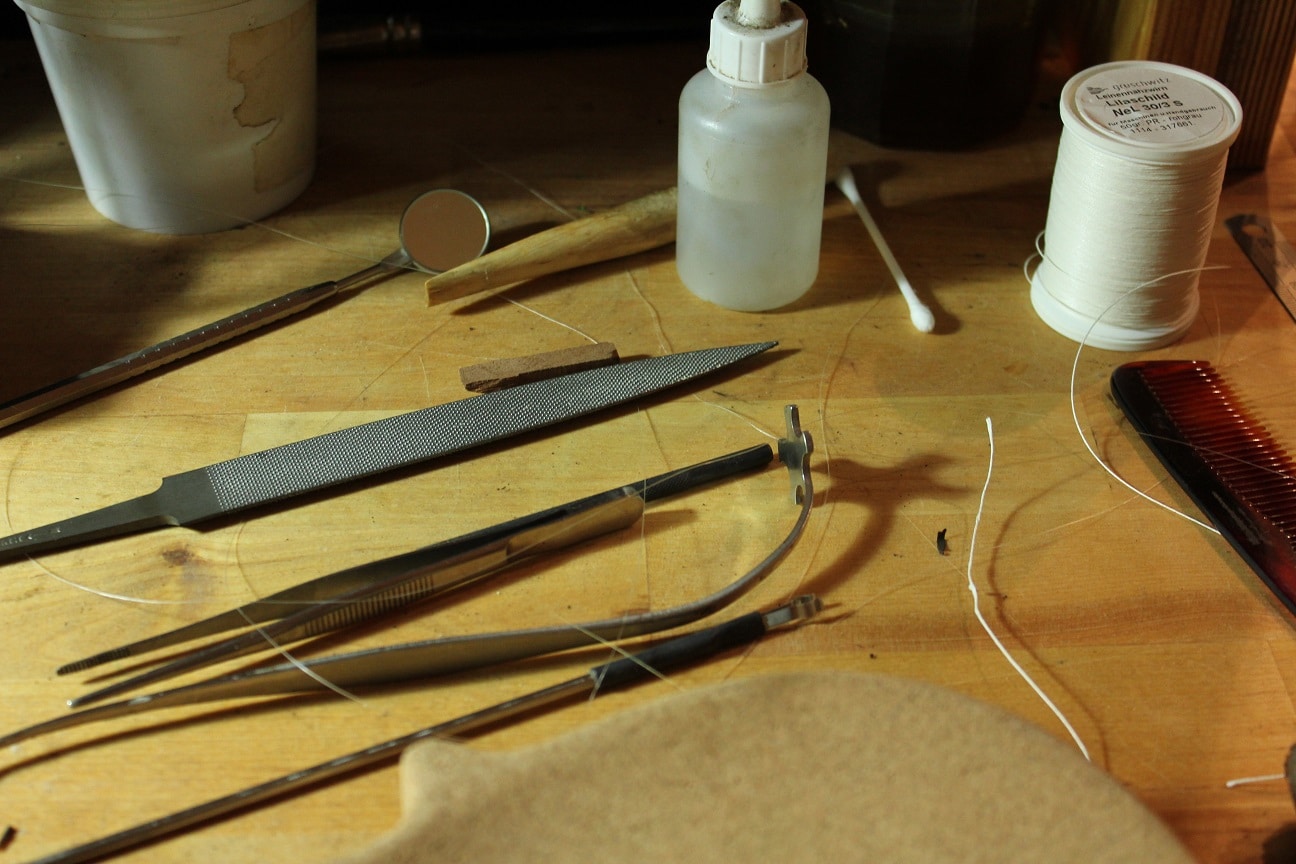
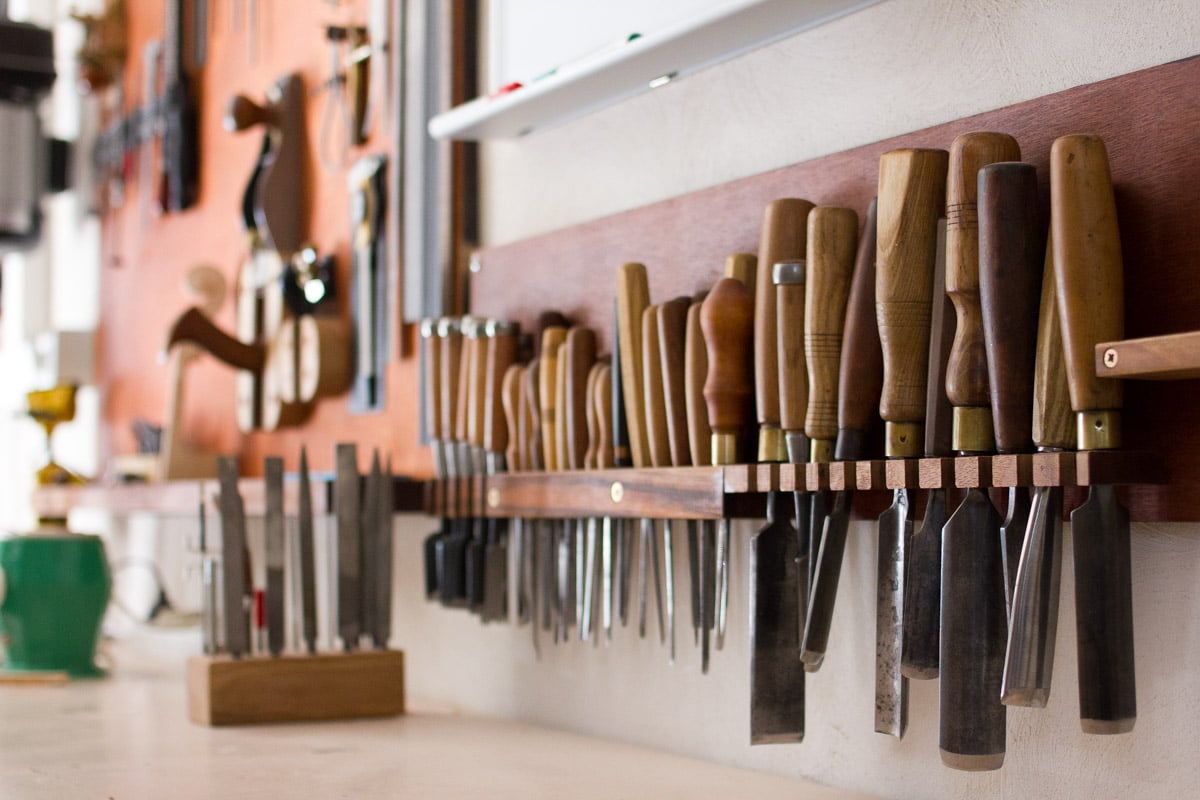
Originally, the luthier was the maker of lutes. But after the decline of this instrument, the meaning of the word broadened to designate the maker of instruments in the violin family(violin, viola, cello, also known as string quartet). By extension, the term sometimes designates the maker of bowed or plucked string instruments with a neck(guitars, mandolins, double basses, old guitars, etc.). The luthier must know how to repair an old instrument, glue it back together, rebarrel it and maintain it; he or she must also know how to make a new instrument, select the woods and build all the parts from models. He uses tools such as planes, penknives, chisels, gouges(for carving arches and scrolls), saws, calipers(for measuring bottom and top thickness), bending irons and tracers.
Finally, he varnishes the instrument.
Adapted from Encyclopédie Larousse[/pullquote]
The origins of the quartet luthier's craft
Violin-making workshops have always produced instruments that were fashionable in their time, so lutes, viols and other Renaissance instruments gave way to the violin family during the 16th century in Italy, and were gradually democratized in the rest of Europe. While violins, violas and cellos were still found in their Baroque form, the early 18th century saw a standardization of shapes and proportions around the models of well-known luthiers. These ingenious craftsmen, such as Amati, Stradivari and Guarneri , produced instruments that are still the stuff of dreams today, and gave Cremona, their home town, an international reputation. They also gave their profession its letters of nobility, and are the source of many mysteries.
The evolution
Over the centuries, needs have changed, as have instruments and musicians. Luthiers had to adapt to demand, and instruments were transformed as a result. There were also many more antique instruments on the market, and as these became more precious, they also required special care. Today, we operate on the borderline between innovation and tradition, with our materials and manufacturing processes fundamentally unchanged, but with state-of-the-art technology at our disposal.
Although a very old profession, luthiers are still far from extinction. But it still has to adapt, as it always has.
The luthier's craft today
Currently in France, according to a census carried out by theInstitut technologique européen des métiers de la musique(ITEMM), some 400 luthiers were practicing in 2009, mostly in very small businesses( 1 to 3 people). To this number can be added all categories of unofficially established luthiers and hobbyists.
To make a living, most craftsmen set up their own businesses, working alone or with others in the various sectors mentioned below. But it's also possible to find work in prestigious workshops or music stores, although places are highly sought-after and limited.
The luthier's wide range of activities
Today, the luthier's craft can be practiced in many different ways. There are many specializations in which each professional chooses to engage. This may be to meet a specific demand, or simply out of passion. In fact, it's up to each individual to practice his or her art as he or she sees fit.
A luthier may choose to specialize in one or more of these areas, especially when employed(in a large workshop or store), but in general, independent luthiers are obliged to take on most of these aspects in order to make a living. After that, however, they can stick to what suits them best, as opportunities arise.
Here are a few examples.
Manufacturing
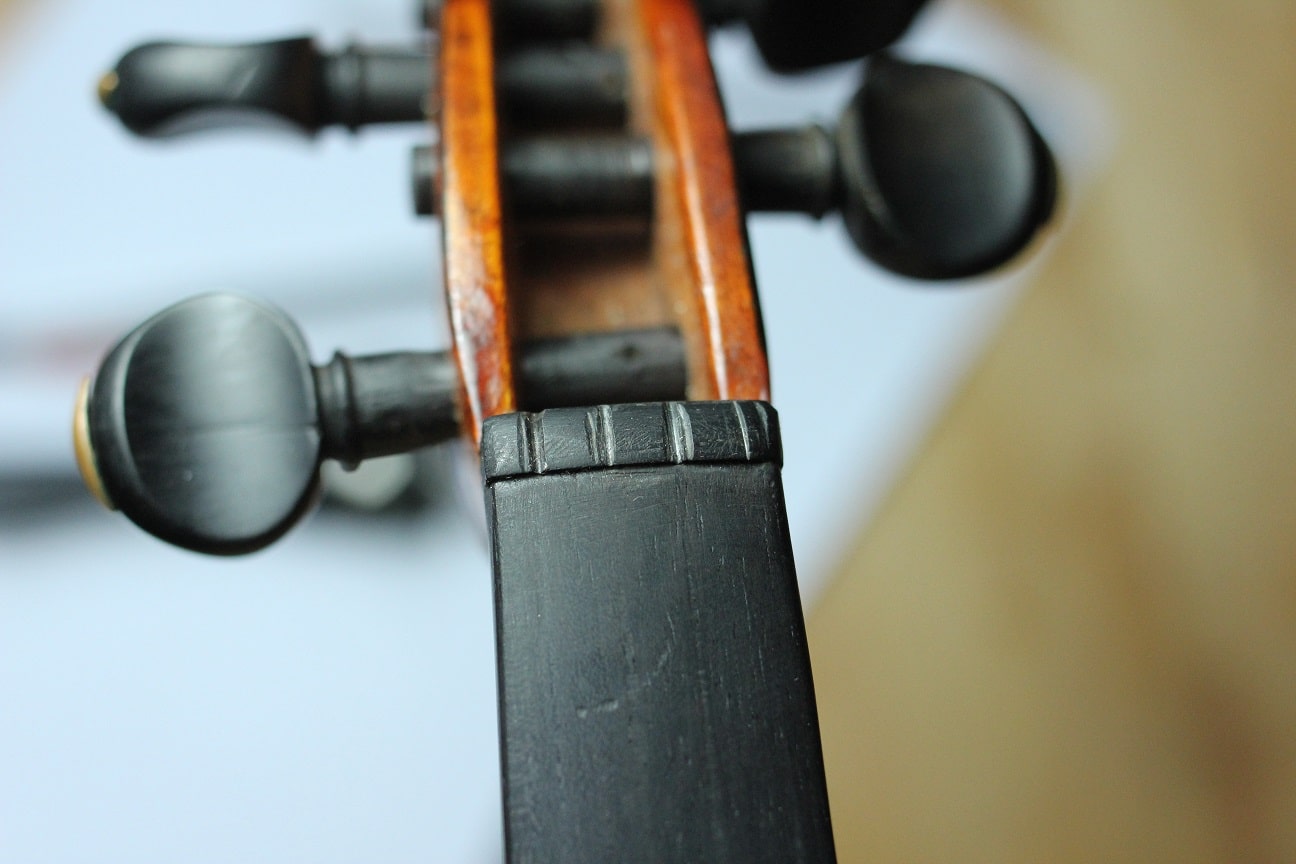
Stringed instrument making is probably the first thing you think of when you think of lutherie. In this case, the luthier transforms beautiful planks of wood into veritable works of visual and sonic art. He can then choose to sell directly to his customers or to specialized dealers.
It's a dream come true for many craftspeople. In reality, however, very few are able to make an exclusive living from it. Those who do succeed rely on a high reputation and, of course, impeccable workmanship.
Adjustment and maintenance
Musicians always need to keep their instruments in top shape. That's why luthiers are there to optimize the playability and sound of violins, violas and cellos. Indeed, most manipulations require tools and gestures that not just anyone can perform.
Repair and restoration
Repair and restoration are two activities whose nuances are subtle, but whose common goal is to restore unfortunate musical instruments to their original condition.
Some high-value instruments require extensive intervention using sophisticated techniques. These delicate operations must be carried out by experts to avoid irreversible damage to the original materials.
Archaeology
It's not uncommon for luthiers to offer bow services. They usually offer rehairing and other minor repairs on bows in addition to sales. Some luthiers also make their own bows, but if this becomes exclusive, they become bow makers.
Expertise

There are many areas in which the expertise process can be applied when it comes to lutherie.
Nevertheless, most of the time we refer to these erudite and experienced luthiers who estimate the value of instruments. The documents they issue, usually an attestation of value and a certificate of origin, can be legally exploited. In this case, they receive a commission based on the value of the certified instrument.
Trading
The sale of new and antique instruments and their accessories is undoubtedly the daily business of most craftsmen. Whether it's their own production, antiques or instruments from Chinese factories, the aim is to offer a wide enough range to satisfy everyone. And above all, at prices and qualities that will suit beginners and professionals alike.
Rental
Renting a quality instrument is often an advantage for students who want to learn about the instrument without having to buy one. That's why rental is often a service offered by luthiers. Some even rely solely on rental.
How to become a luthier
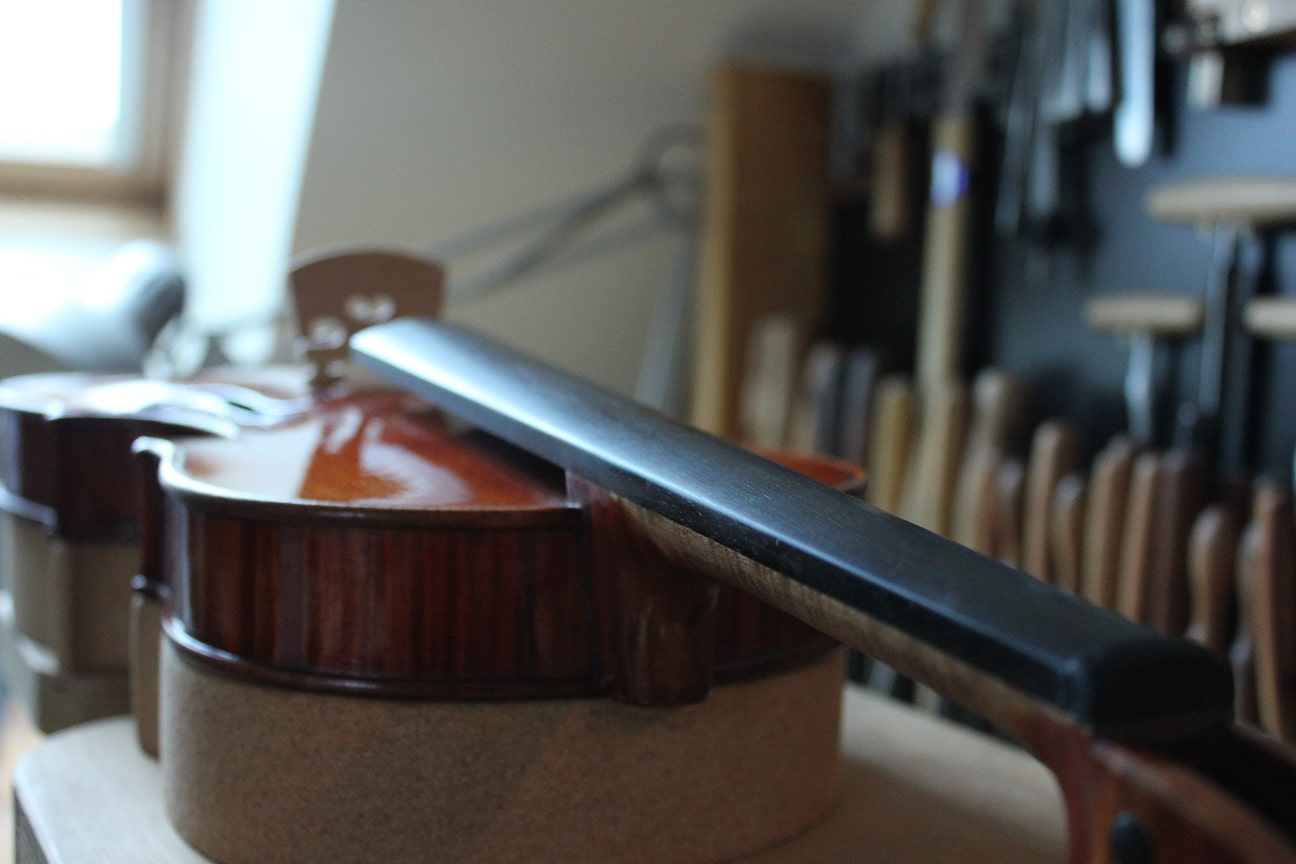
The craft of luthier requires an apprenticeship that represents a huge investment in time and materials. What's more, finding the right training is a challenge in itself. That's why most candidates lack determination and give up.
The main qualities required of a luthier are :
- A liking for manual work(both wood and metal)
- A taste for the physical sciences(mathematics, geometry, physics, chemistry, acoustics)
- Patience and attention to detail
- An ear and a musical culture developed through playing an instrument
A passion above all else
Although many of these qualities are cited as being required, even if only to begin learning violin making. In my opinion, these are merely predispositions, not prerequisites. Why should someone with no taste for music or woodworking consider becoming a luthier? After all, you can learn anything if you put your mind to it. In fact, it's not uncommon for people to retrain at a fairly advanced age.
Training courses
As for the apprenticeship itself, there are several diploma schools in France. These are the official places for teaching lutherie:
- CAP(certificat d'aptitude professionnelle) lutherie and CAP ouvrier archetier (vocational training certificate in bow making), alternately at CFA SEPR in Lyon
- CAP musical instrument technical assistant, guitar option, at Lycée F. Léger Bedarieux
- BMA technicien en facture instrumentale option guitare: 2 years after the CAP at lycée F. Léger Bédarieux
- FC(complementary training) lutherie: 2 years after the baccalaureate at Lycée George Sand in Briantes
- DMA(diplôme des métiers d'arts) 2 or 3 years after baccalauréat at École nationale de la lutherie. It takes place at the Lycée J-B Vuillaume in Mirecourt (88).
There are many private schools, such as theJean-Jacques Pagès International School of Art Lutherie. However, you can attend short courses or workshops to learn or get an idea of the work involved.
Around the world
It's not unusual for French people to study violin making abroad. Here are a few of the most famous schools:
- Newark & Sherwood Violin Making School(Newark - England)
- London Metropolitan University(London - England)
- Mittenwald(Mittenwald - Germany)
- Scuola Internazionale di Luteria(Cremona - Italy)
- Scuola di Liuteria di Parma(Parma - Italy)
- Civica Scuola di Liuteria di Milano(Milan - Italy)
- Violin Making School of America(Salt Lake City - EU)
- School of Violin Making (Chicago - EU)




Thank you for this very rich documentation, everything has become clearer for me... Olivier Boyer
Thank you