
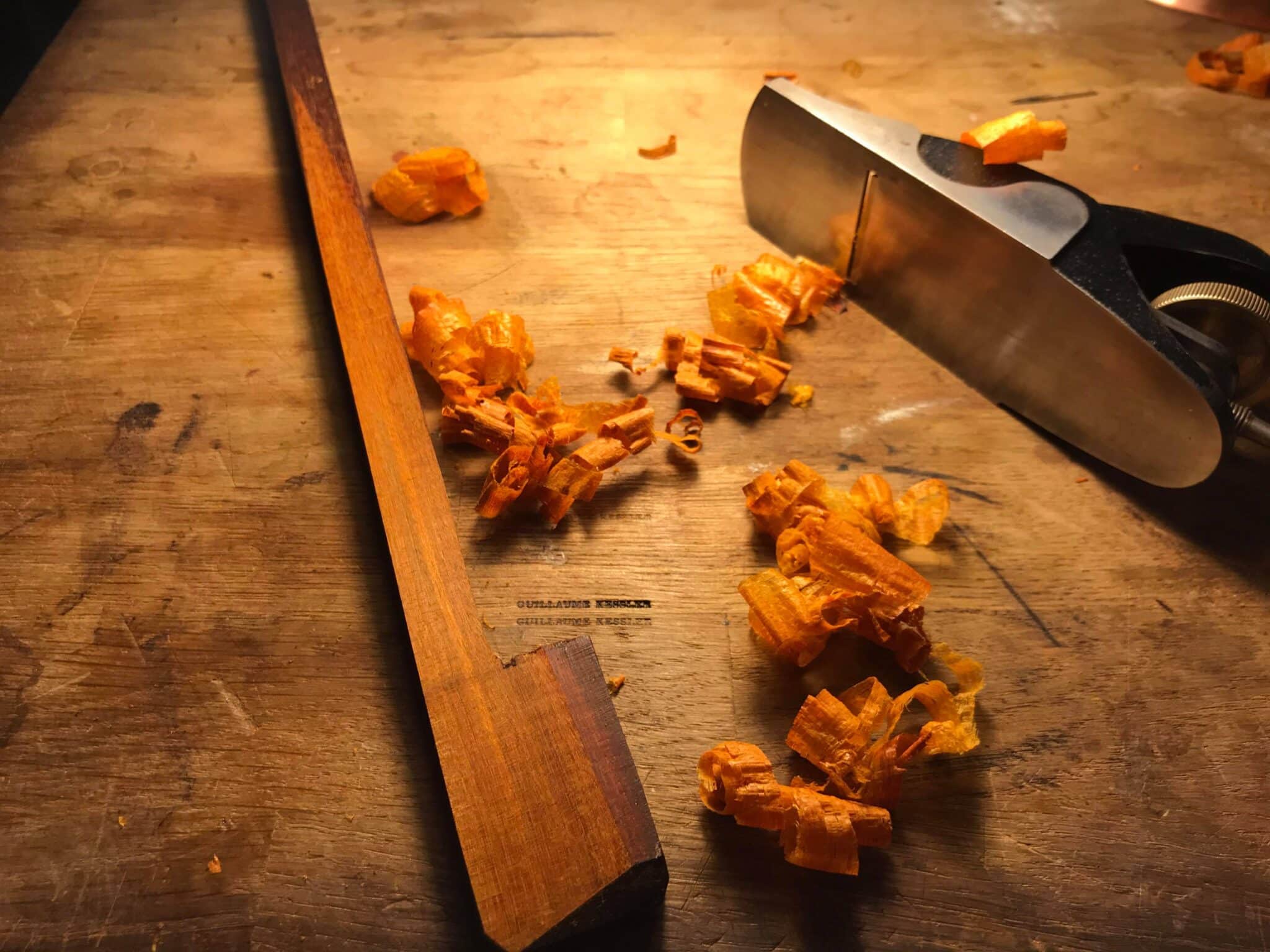
Since the beginning of the summer, bow makers around the world have been shaking in their boots. These craftsmen, of whom there are some 600 worldwide, have learned that Brazil intends to completely stop marketing this wood, which is indispensable to modern bow making. The South American country, where the ember-colored species is endemic, has declared that it is preparing an amendment to ban all trade and circulation of pernambuco worldwide. This decision will be taken at the next CITES meeting from November 14 to 25 this year. This raises a burning question: are we witnessing the end of pernambuco? And should we redefine the bow as we know it?
The end of Pernambuco
To begin with, I'd like to point out that bows weren't always made of pernambuco. However, the modern bow, developed by French bow maker François-Xavier Tourte in the late 18th century, was inseparable from this exotic essence. This father of modern bow making defined the sound and playability we know today through his design and the use of a stick fashioned from this wood. This combination is now so ingrained in musicians' fingers and ears, that it seems inconceivable to use any other species.
However, after an initial protection measure in 2007, at CITES in The Hague, certain protection measures were put in place by classifying the species Paubrasilia echinata in ANNEX II. This measure required all existing stocks in all companies to be inventoried. As a result, all the wood present in stocks in 2007, and therefore pre-dating the convention, is now the only wood that can be legally used. The other problem is that Brazil has made no provision for harvesting or export quotas.
The problem of illegal timber
It's interesting to note that, since 2007, the archaeology industry has been living off its reserves. Or rather, that there is a highly developed parallel and illegal market to supply the entire industry in complete secrecy. And it's these that have been targeted by the Brazilian authorities in recent months. Not only the "poachers" who cut down trees in the forest, but also the transporters who travel the world with their suitcases full of illegal wood. I had the opportunity to see some documents showing the seizures, and it was quite impressive.
But what does the future hold for thepernambuco bow?
The consequences of the end of pernambuco
In fact, if pernambuco were to be included in ANNEX I, the consequences would be far-reaching. For bow makers and musicians alike. Firstly, the scarcity of raw materials would drive up prices, whether for modern or old-fashioned instruments. This would affect trade and consumption in equal measure.
In fact, as soon as the amendment was announced, the bow and music industry was already preparing for the worst. Many manufacturers have turned to alternative bow production. For others, reinvention is out of the question, and they prefer to throw in the towel. Of course, the companies that depend on the sale of these bows have not hesitated to buy up all available stock. Indeed, it's already back to school, and perhaps the last time we'll be able to buy a pernambucco bow as we used to.
Bow makers
In concrete terms, craftsmen will only be able to use wood dating from before 2007.
In fact, by seeking to preserve biodiversity, it is the variety of bow makers that will decrease. Even if those with sufficient stock dating from before 2007 will no doubt be able to continue producing without any problem. However, it is the young bow makers or those who have never had the opportunity to build up stock who will find themselves in a very precarious situation and will have to make a choice: transform their activity or stop.
The big loser in this situation: the musician
Despite the profound changes that the bow industry will undergo, the musician will be the hardest hit by these measures. Firstly, the price of new and old pernambuco bows will rise. Secondly, it will also be very difficult to travel with one's instruments.
In fact, the essence we're talking about here will be strictly forbidden, along with ivory, in all its movements. To be clearer, each bow will have to have an official authorization. In other words, you'll need to produce certification for the bow you own or the wood used in its construction. This will have to prove that it dates from before the first date of entry on the register, in 2007. If you don't, you're asking for trouble.
This has already been the case with ivory and tortoiseshell bows for many years. Now, however, all pernambuco bows will be subject to the same rules, and that's going to take a lot of work. Here's an article from a few years ago about a Swiss orchestra on tour in the USA. It illustrates the many problems facing professional and amateur musicians wishing to travel.
Musical instrument certificate (CIM)
To take the specific example of the United States, all trips require a special permit for each instrument. On top of this, there are only a handful of ports of entry in the country(17 in the U.S.) with the appropriate departments to validate the permits. This makes travel organization extremely complex.
But first, the musician must prove that the wood used dates from before September 13, 2007. It doesn't matter whether the bow was made before or after this date. For this, an invoice may suffice, but otherwise you'll need to obtain a materials certificate and have it validated by the specific organizations.
I'll be talking in detail about the Certificat d'Instrument de Musique and how to obtain it in France in another article.
How do you adapt to the situation?
In fact, unions and professionals will be doing everything in their power to make the restrictions less severe. But even if they succeed, we'll still have to adapt. The question is how...
Of course, alternatives to all bow materials have long been available. Whether synthetic or other species, there are always solutions. But let's face it, using a different material will always have an impact. In fact, the sound and playability will inevitably be different. But there are solutions:
- Alternative, local or exotic species have always been used to create bows. Perhaps we should explore new possibilities with these?
- On the other hand, there's a lot of innovation going on with carbon drumsticks, and some musicians choose to use just that.
A bulwark against the end of pernambuco: IPCI
IPCI is an organization that has been fighting for the protection of pernambuco for many years. In fact, its actions have been widely praised and even described as exemplary by CITES participants.
If you are interested in their actions, please follow this link: http: //www.ipci-comurnat.eu/.



Yet another arbitrary, ill-considered decision, to put it mildly. The number of active bow makers is not that high, and pernambuco is not - as far as I know - an endangered species. Would Brazil want to favor its own bow makers, who have unlimited access to this wood? Otherwise, I've heard that certain fruit trees (corm?) can give similar results in terms of handling and sound. Amourette and ironwood (Pau ferro) have also been used... will these latter species also be threatened? I understand the concern for biodiversity, but is a planet without musicians worth it?
It's a pity that some E****** use such magnificent species to make furniture or static, solid objects! It's not these types of craftsmanship that threaten this species! I'm also disgusted to see that Biodiversity, a serious and vital subject if ever there was one, is also being managed by the COP! these mythomaniacs, pseudo-ecologists but real dystopian ideologues intent on torpedoing global growth. Those who believe that man is more powerful than Pinatubo and attribute to him the normal Aleas of the climate through the ages!